
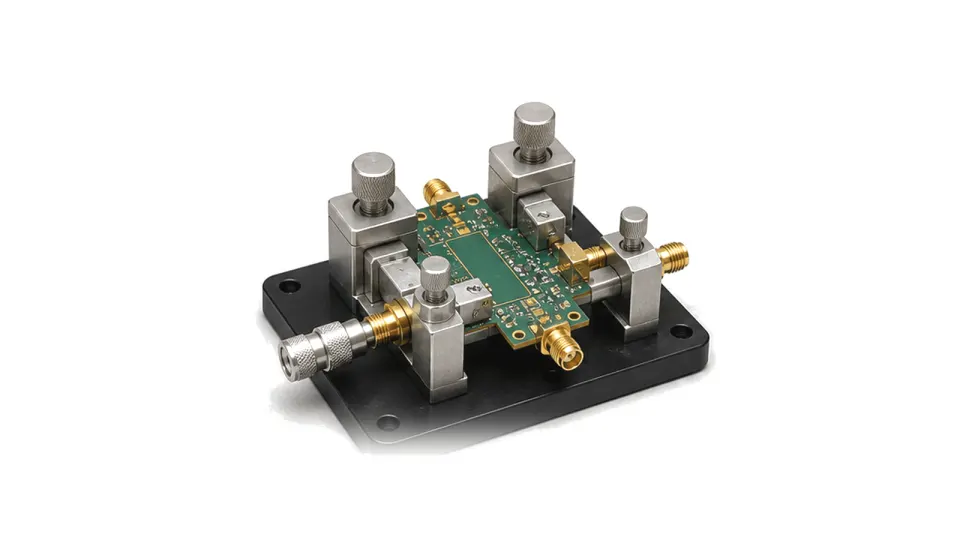
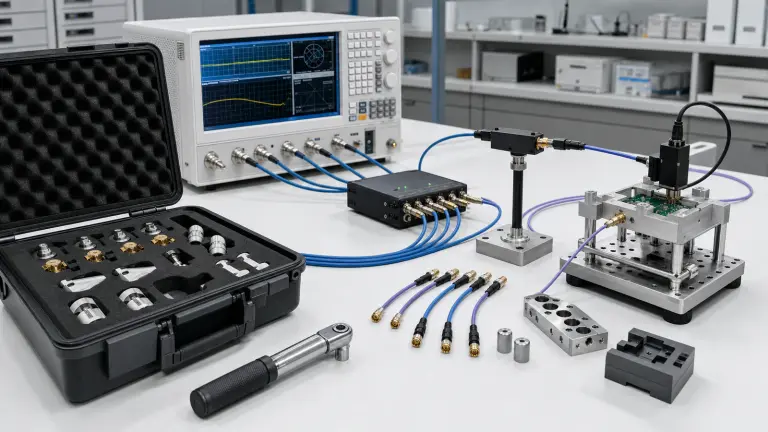
RF Test Fixtures
RF test fixtures make a device repeatable to test by controlling how it is held, contacted, grounded and connected. They are part of the measurement setup rather than the RF component being characterized.
Verification role
They are used for lab checks, production screening, acceptance tests and repeated electrical access to modules, boards or assemblies.
Key data
Important data includes DUT format, connector access, contact method, path loss, grounding, mechanical repeatability, usable frequency range, power limit and maintenance notes.
What does the Test Fixtures category cover?
RF test fixtures hold, contact or route a device during lab and production verification. They keep the mechanical position, RF path and electrical access consistent across repeated tests.
How should hardware in the Test Fixtures category be selected?
A practical method for specifying RF calibration kits, cables, adapters, switch matrices, signal-conditioning paths, probes and fixtures by interface, reference plane, repeatability, traceability, verification and lifecycle controls.
- Treat the complete physical path as the controlled measurement hardware
- Define the measurement task and the hardware boundary
- Freeze the DUT interface and corrected reference plane
Which specifications matter when evaluating Test Fixtures?
Important data includes DUT format, connector access, contact method, path loss, grounding, mechanical repeatability, usable frequency range, power limit and maintenance notes.
How should hardware in the Test Fixtures category be tested and verified?
Specify RF test and calibration hardware as one controlled path from the instrument test port to the DUT reference plane. Freeze connector or probe interface, continuous frequency range, level and power limits, calibration method, kit definition, cable and switch paths, fixture geometry, contact practice, connector care, verification artifact, traceability records and replacement triggers. A completed calibration or a calibrated artifact alone does not prove that the assembled path remains accurate after remating, flexing, switching, wear, drift or a fixture revision.