LCRF

Privacy preferences

Choose optional purposes independently. You can change or withdraw your choice at any time from the footer.

Strictly necessary

Required for security, session functions and storing your privacy choice.

Always active
Preferences

Remembers optional display or language settings when these features are enabled.

Analytics

Uses first-party visitor and session identifiers to measure pages, referrals and inquiry interactions.

Marketing

Allows marketing measurement or third-party advertising technologies if they are introduced in the future.

RF Engineering Capabilities

See how LCRF frames RF requirements, evaluates component and signal-chain fit, defines verification evidence and records project scope.

RF and microwave modules connected on a representative signal-chain evaluation fixture

Engineering scope

Turn an RF requirement into a reviewable project scope

LCRF supports the technical path between early hardware discovery and an issued project record. The work begins with operating conditions and system boundaries, then connects suitable product families, interfaces, verification needs and documentation expectations.

The review can cover components, modules, interconnects, instruments and subsystem assemblies across source, conversion, gain, filtering, distribution, switching, monitoring, antenna, power, thermal and test paths. The depth depends on the exact product and project stage; it is not a blanket claim that every item includes design, qualification or custom testing.

A useful result is not a long list of parts. It is a controlled statement of what is being evaluated, which assumptions remain open, what evidence is available and which configuration, tests, documents and obligations are included in the issued offer.

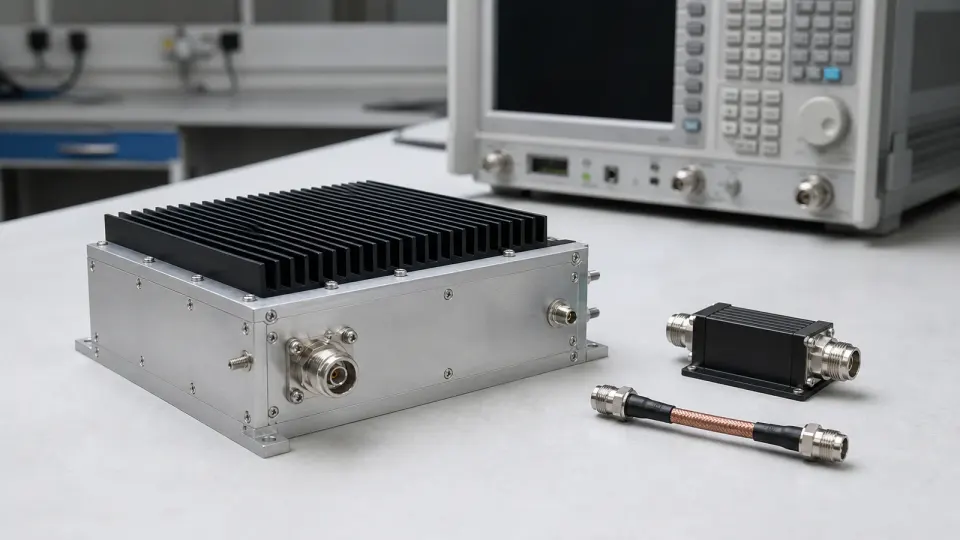
Representative RF characterization path with instruments, modules and controlled interconnects
A defensible result depends on the signal conditions, reference planes, interconnects, loads and instrument settings used to obtain it.

Capability areas

Four workstreams that keep technical decisions traceable

Each workstream answers a different project question and produces information that can be reviewed by engineering, sourcing and quality teams.

Requirement and product-family review

Define the band, gain or loss, output or noise target, linearity, waveform, duty cycle, impedance, quantity stage and operating environment before narrowing the hardware path.

  • Candidate product families and standard configurations
  • Missing inputs, conflicts and feasibility questions
  • Comparison dimensions tied to the actual RF task

Signal-chain and interface review

Examine how adjacent stages interact, including drive and compression margin, filtering, LO/IF planning, isolation, switching, mismatch, connector or waveguide interfaces, supply, bias, control and thermal removal.

  • Functional block and interface boundaries
  • Integration assumptions and risk points
  • Mechanical, electrical and control information still required

Verification and acceptance planning

Define the conditions under which performance is meaningful: stimulus, waveform, reference plane, calibration state, interconnect loss, load, temperature, cooling and pass/fail limits.

  • Relevant parameters and test conditions
  • Available evidence and evidence gaps
  • Project-specific acceptance criteria for agreement

Technical records and change control

Keep product identity, revision, drawing, datasheet, test reference, compliance evidence and offered configuration aligned so teams do not make decisions from disconnected files.

  • Document and revision list for the offered item
  • Exceptions, substitutions and open actions
  • Issued technical and commercial scope

Project review sequence

Five gates from first requirement to controlled offer

The sequence is deliberately staged so unresolved assumptions are visible before they become schedule, performance or acceptance problems.

  1. 01

    Capture the operating case

    Record the RF task, band, signal conditions, interfaces, environment, project stage, quantity and timing.

  2. 02

    Set the technical boundary

    Separate product performance from system-level assumptions and identify adjacent stages that influence the result.

  3. 03

    Build the candidate path

    Map the relevant product families, standard options and any route that needs feasibility review.

  4. 04

    Review evidence and exceptions

    Check revisions, test conditions, drawings, available reports, compliance evidence and remaining gaps.

  5. 05

    Issue the agreed scope

    Record configuration, quantity, tests, documents, acceptance basis, schedule, delivery and contracting details.

Information to provide

Project facts that make RF review productive

  • Frequency range, signal type, bandwidth and waveform or duty cycle
  • Gain, loss, output power, noise, linearity, isolation or switching targets
  • Source and load impedance, connector or waveguide interface and cable path
  • Supply, bias, control, mechanical envelope, cooling and ambient conditions
  • Qualification or compliance context, quantity stage, schedule and destination
  • Required datasheet, drawing, test evidence, inspection or delivery records

Review outputs

Records that support the next decision

  • Candidate product path with the assumptions used to build it
  • Parameter and interface comparison for the stated operating case
  • Open technical questions, evidence gaps and project risks
  • Available document list and proposed verification boundary
  • Configuration and exceptions stated in the quotation or project record
  • Agreed tests, documents and acceptance basis when included in scope

Evidence hierarchy

Use each record for the decision it can actually support

Separating discovery information from issued evidence prevents assumptions from being carried into design reviews or purchasing decisions.

Public product and application information

Supports discovery, initial comparison and preparation of engineering questions. It does not confirm a project-specific configuration or acceptance result.

Datasheet, drawing and revision record

Identifies the product and published specification boundary for the stated revision, including interfaces and conditions explicitly shown.

Test data and inspection evidence

Supports only the unit, setup, reference plane, stimulus, environment and limits documented in the applicable record.

Quotation, contract and issued project records

Control the offered configuration, responsible seller, included tests and documents, acceptance basis, commercial terms and delivery obligations.

Start with the engineering facts

Bring the operating case, not just a part name

Use the product directory when the family is known. Send a project inquiry when the signal chain, interfaces, environment, evidence or documentation boundary still needs to be defined.