
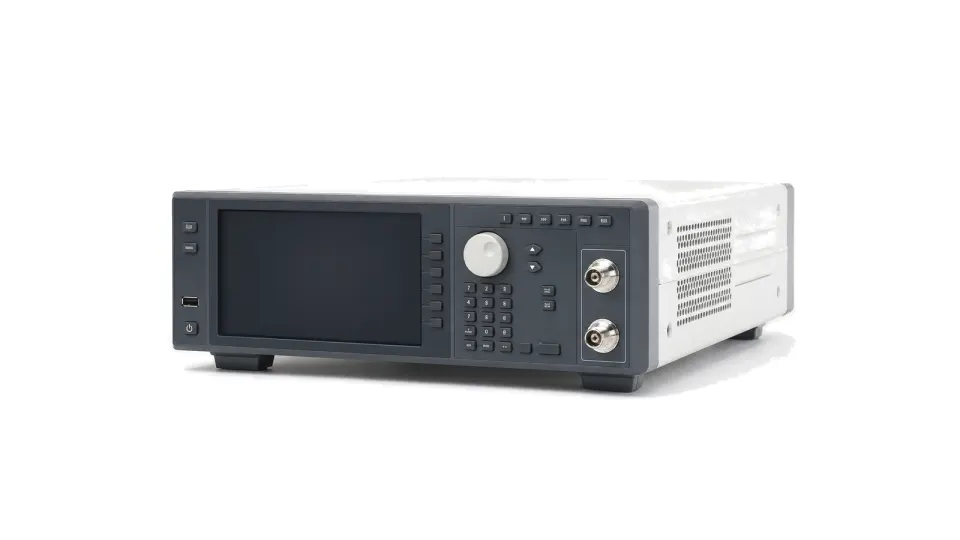
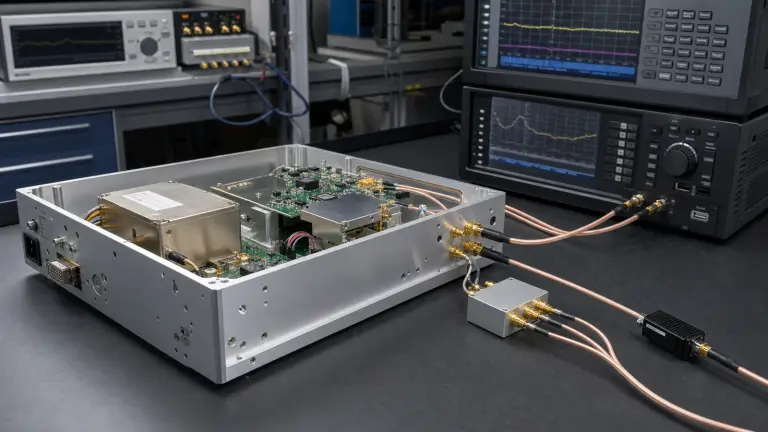
RF Signal Generators
RF signal generators produce controllable RF or microwave test signals with defined frequency, output level, modulation and sweep behavior.
Signal role
A signal generator supplies a known stimulus for receiver checks, converter tests, amplifier characterization and system verification.
Key data
Relevant data includes frequency range, output power range, level accuracy, phase noise, modulation formats, sweep capability, reference input, trigger and remote-control interface.
What does the RF Signal Generators category cover?
RF signal generators produce controllable RF or microwave test signals with defined frequency, output level, modulation and sweep behavior.
How should hardware in the RF Signal Generators category be selected?
A practical method for turning carrier, tuning, spectral-purity, reference-stability, switching and phase-coherence needs into an RF source specification that can be measured and accepted.
- Write the source requirement at the system boundary
- Freeze the source contract before comparing architectures
- Specify phase noise as a system mask, not a brochure spot value
Which specifications matter when evaluating RF Signal Generators?
Relevant data includes frequency range, output power range, level accuracy, phase noise, modulation formats, sweep capability, reference input, trigger and remote-control interface.
How should hardware in the RF Signal Generators category be tested and verified?
Specify an RF signal source at a named output reference plane and under a defined load, power, temperature and control state. Freeze the carrier ranges, step size, output level and waveform; allocate phase-noise limits over the offset regions that affect the system; bound harmonics, nonharmonic spurs and broadband noise; separate initial accuracy, temperature stability, aging and holdover; and define settling with a measurable error band and deadline. A shared reference or asserted lock signal is not proof of phase coherence or completed settling, so acceptance must retain traces from the actual tuning, restart and environmental states.
How to Specify an RF Signal Source: Phase Noise, Spurs, Settling and Stability