
LCRF

Privacy preferences

Choose optional purposes independently. You can change or withdraw your choice at any time from the footer.

Strictly necessary

Required for security, session functions and storing your privacy choice.

Always active
Preferences

Remembers optional display or language settings when these features are enabled.

Analytics

Uses first-party visitor and session identifiers to measure pages, referrals and inquiry interactions.

Marketing

Allows marketing measurement or third-party advertising technologies if they are introduced in the future.

RF Front-End Modules

RF front-end modules combine the RF functions placed between an antenna, connector interface or transceiver and the rest of the signal chain. They may include filtering, switching, gain, protection, detection and controlled interconnect.

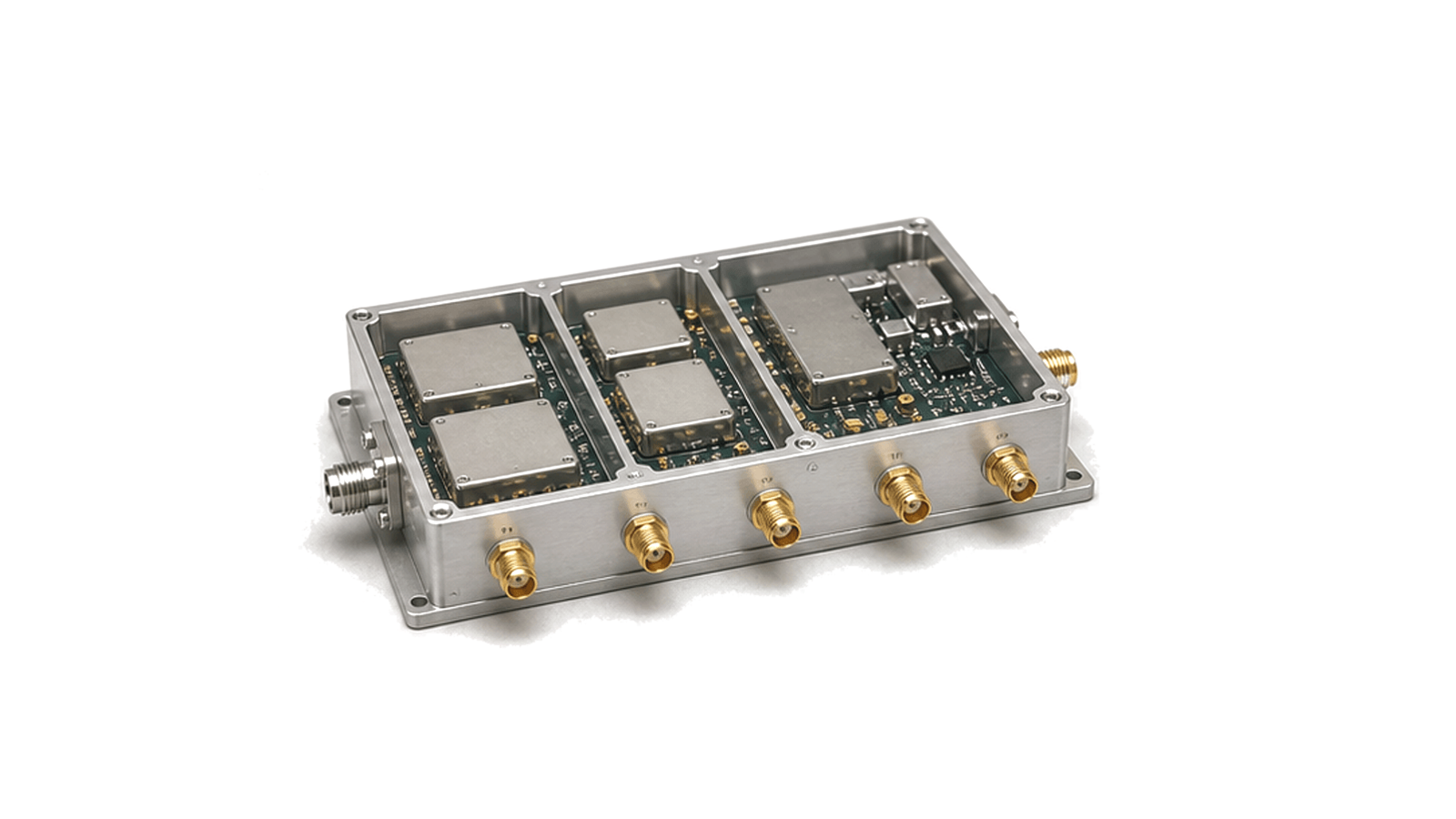
RF front-end module with shielded housing and coaxial connectors

FAQ

How should TDD and FDD RF front-end isolation requirements differ?

FDD requires continuous isolation between simultaneous transmit and receive bands, while TDD requires switched isolation plus controlled transients, blanking and receiver recovery before the receive interval.

How do bandwidth, noise figure and required SNR determine RF receiver sensitivity?

Receiver sensitivity is the thermal noise in the defined bandwidth plus cascaded noise figure and the SNR or Eb/N0 required by the actual waveform, with explicit implementation and measurement margin.

Engineering inquiry

Share your RF requirement

Share the product, operating requirements and project context. Our engineering team will route your request to the right specialist.

AttachmentsAttach drawings, BOMs, specifications or test files. Up to 5 files, 10 MB each and 25 MB total.
or drag and dropPDF, DOCX, XLSX, CSV, TXT, JPG, PNG, S1P and S2P
Typically reviewed within one business dayProject information is handled confidentially

RF front-end modules

RF front-end modules collect the interface functions that condition a signal before it enters or leaves a larger RF system. A module can combine filters, switches, low-noise or driver gain, limiters, couplers, detectors, bias routing and monitored interconnect inside one mechanical boundary.

Interface behavior

Important data includes operating band, insertion loss, return loss, rejection, noise contribution, linearity, power handling, isolation, switching method, control interface, supply requirements, connector type and thermal path. These values determine how the module behaves at antenna feeds, radio equipment interfaces, test ports and compact RF assemblies.