
LCRF

Privacy preferences

Choose optional purposes independently. You can change or withdraw your choice at any time from the footer.

Strictly necessary

Required for security, session functions and storing your privacy choice.

Always active
Preferences

Remembers optional display or language settings when these features are enabled.

Analytics

Uses first-party visitor and session identifiers to measure pages, referrals and inquiry interactions.

Marketing

Allows marketing measurement or third-party advertising technologies if they are introduced in the future.

Radar Front-End Assemblies

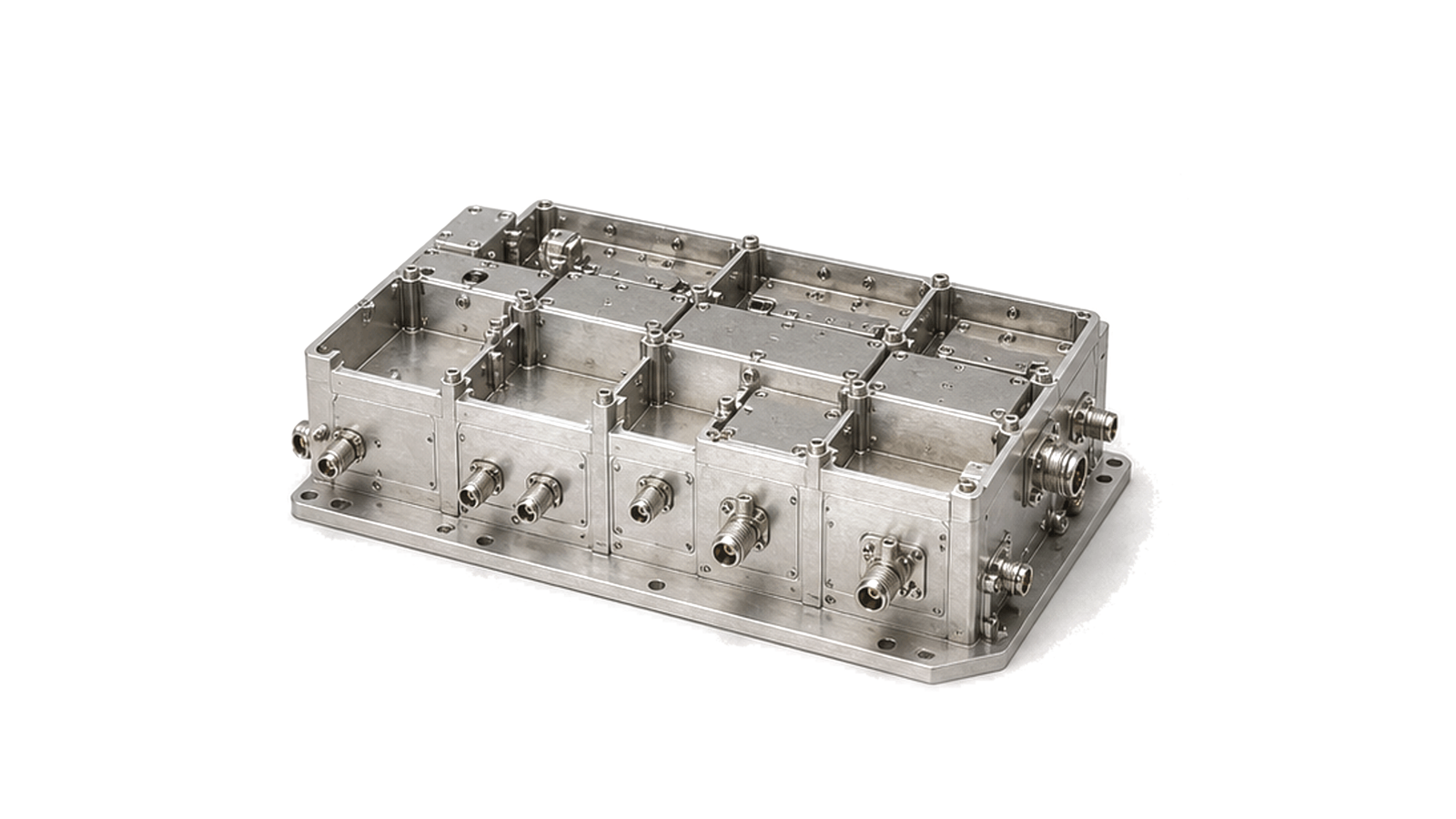
Radar front-end assemblies combine antenna-facing switching, protection, filtering, gain and frequency functions around a radar transmit or receive path. They are used where timing, phase behavior, pulse power and receiver protection must stay controlled.

Radar RF front-end assembly with coaxial connectors and protected signal paths

FAQ

How do amplitude and phase errors affect a phased-array radar RF front end?

Channel amplitude and phase errors change coherent addition, beam direction, gain, sidelobes and null depth; their allowed distribution must be tied to the array pattern and calibration model.

What must a radar Tx/Rx protection requirement include beyond receiver survival?

A complete Tx/Rx protection requirement includes survivable peak and average leakage, limiter and switch behavior, residual level, overload recovery, post-pulse gain/noise/phase and the nearest usable range gate.

Engineering inquiry

Share your RF requirement

Share the product, operating requirements and project context. Our engineering team will route your request to the right specialist.

AttachmentsAttach drawings, BOMs, specifications or test files. Up to 5 files, 10 MB each and 25 MB total.
or drag and dropPDF, DOCX, XLSX, CSV, TXT, JPG, PNG, S1P and S2P
Typically reviewed within one business dayProject information is handled confidentially

Radar front-end assemblies

Radar front-end assemblies sit close to the antenna path and organize the RF functions needed before or after the radar aperture. Depending on the radar architecture, the assembly may include T/R switching, limiters, filters, low-noise gain, driver or power stages, couplers, detectors, converters and monitored interconnect.

Radar path behavior

Important data includes operating band, pulse width, duty cycle, peak or average power, receive noise contribution, insertion loss, isolation, recovery time, phase stability, timing control, protection threshold, connector format and thermal path. These values affect range, sensitivity, clutter behavior, channel matching and serviceability in surveillance, tracking, navigation, test and counter-UAS radar hardware.