
LCRF

Privacy preferences

Choose optional purposes independently. You can change or withdraw your choice at any time from the footer.

Strictly necessary

Required for security, session functions and storing your privacy choice.

Always active
Preferences

Remembers optional display or language settings when these features are enabled.

Analytics

Uses first-party visitor and session identifiers to measure pages, referrals and inquiry interactions.

Marketing

Allows marketing measurement or third-party advertising technologies if they are introduced in the future.

Horn Antennas

Horn antennas use a flared waveguide structure to produce predictable microwave radiation, gain and beamwidth. They are used as test antennas, radar feeds, reference antennas, EMC fixtures and microwave link components.

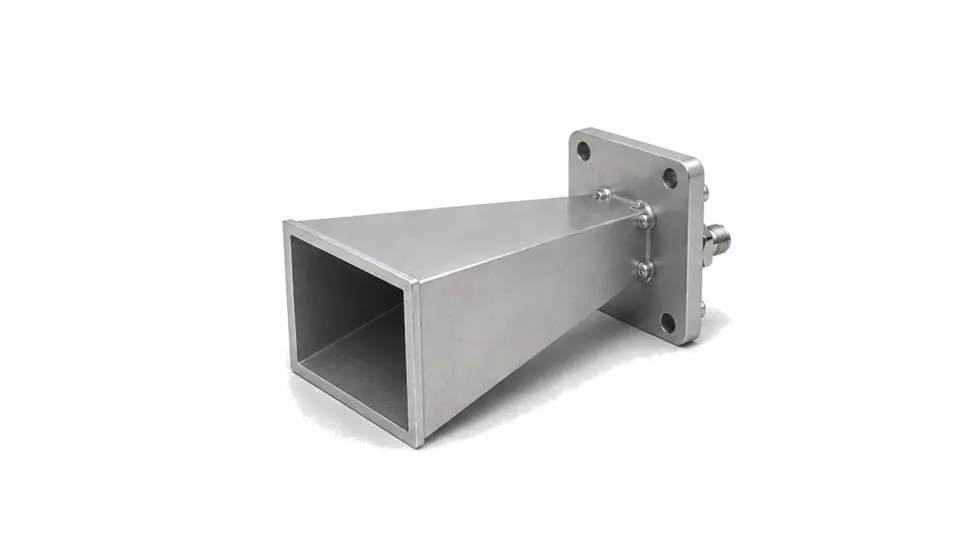
Microwave horn antenna with flared waveguide aperture

FAQ

What is the difference between antenna gain, directivity, beamwidth and sidelobes?

Directivity describes angular concentration, gain includes dissipative efficiency, beamwidth describes main-beam extent and sidelobes describe radiation outside that beam.

Why can an installed antenna pattern differ from the free-space data sheet?

Ground planes, structures, cables, radomes and mounting tolerances change current distribution and scattering, which can alter match, gain, pattern, polarization and phase center.

How are antenna VSWR, return loss, reflection coefficient and mismatch loss related?

VSWR, return loss and reflection coefficient express port mismatch; mismatch loss quantifies the accepted-power penalty, but none proves radiation efficiency or pattern.

Engineering inquiry

Share your RF requirement

Share the product, operating requirements and project context. Our engineering team will route your request to the right specialist.

AttachmentsAttach drawings, BOMs, specifications or test files. Up to 5 files, 10 MB each and 25 MB total.
or drag and dropPDF, DOCX, XLSX, CSV, TXT, JPG, PNG, S1P and S2P
Typically reviewed within one business dayProject information is handled confidentially

Horn antennas

Horn antennas use a flared waveguide aperture to transition RF or microwave energy between a guided path and free space. The geometry provides predictable gain, beamwidth and polarization behavior, which makes horn antennas useful when a stable reference or controlled radiating element is required.

Reference and feed applications

Key data includes frequency band, waveguide size or flange, aperture dimensions, gain, beamwidth, polarization, VSWR, power handling, connector or waveguide interface, mounting and calibration information. Horn antennas are commonly used in microwave test setups, radar feeds, EMC measurements, antenna ranges and point-to-point microwave links.